
Sometimes it’s hard not to despair at the state of the modern world. Technologies evolving at a dizzying pace, the ever-increasing digitalisation of our lives, the knowledge that new fields of work are emerging every day that no longer require human involvement to get the job done.
These are the general problems and questions affecting all of us, the ones we have to cope with every day. Then there are the personal ones. In my case, it’s the fact that I’m getting older, something I’m constantly being reminded of. The fact that some of my joints don’t quite work the way they used to. That my hormones wake me up in the middle of the night, and my brain decides that 2.30 am is a great time to start thinking about the upcoming day’s to-dos.
Through this experience, I can say that I’ve rediscovered the dancefloor as a coping mechanism, as a place where I feel connected to other people while also feeling completely at ease with myself. If you think clubs are exclusively for young people, you’re wrong. There are few places where I feel less like my age, who I am in general, or what I’m doing here even matters. Dancing together is the ultimate human experience for me, one that has helped me enormously over the past few years in maintaining both my mental and physical health.
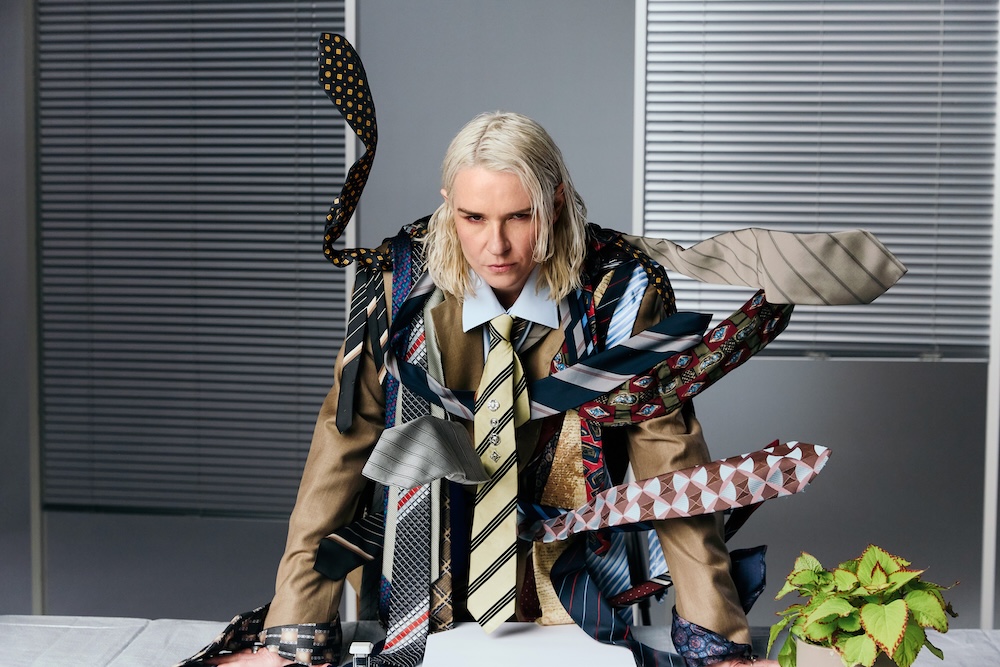
Last year, London-based musician, producer and DJ Teneil Throssell, aka HAAi, released HUMANiSE, an album exploring the friction between the human and the digital, and whether it’s possible to bring the two into harmony. Now its follow-up, DIGITiSE, has arrived. It not only continues to explore these questions but also picks up on the musical themes of HUMANiSE and takes them somewhere HAAi feels equally at home: the dancefloor.
And this is where our paths cross, at the perfect moment. It’s not the first time I’ve had the chance to see her, either. Last year, I was lucky enough to dance to her set on the opening night of Fred again..’s USB002 Tour in Glasgow. Ever since, I’ve been looking forward to finally asking her about her wicked dance moves.
Beyond that, we talk about the dancefloor as a place of connection and healing, about how her work as a DJ influences her work as a producer, musician and live performer, and, of course, about her new album DIGITiSE, which has turned out to be so much more than a remix version of HUMANiSE. Meeting HAAi in person gives you a real sense of why the world of electronic music is such a warm and welcoming place.
I saw you last year when you played with Fred again.. for his first ever USB show in Glasgow. And I remember thinking: She’s got some serious dance moves!
Ah, yay! (laughs) Well, I had to get it out of the system that night, because I was meant to play a full set and then back to back with Fred. My flight was meant to land in Glasgow, but there was this bad storm, so the flight landed in Edinburgh. We thought there was still enough time if we got a driver to drive us from the airport in Edinburgh to Glasgow. It’s like an hour. It didn’t seem that catastrophic. But the storm was so bad we couldn’t get off the plane. There was no possibility unfortunately to swap with the other DJs. So I ended up missing a big chunk of my set, which was a bummer. Oh, but it was a story. And Fred and I still got to do our back to back. But yeah, by the time I got there, I had so much to get out of my system. My album was out, it was a 10.000 capacity show… there were a lot of big feelings on that day. I was like: If you think I’m going to miss this, you’re crazy (laughs). But it was a super fun night in the end. I definitely had a few drinks to celebrate.
“I really wanted it to be a bit of a snapshot of me as a DJ”
I listened a lot to HUMANiSE after that show and was amazed how much of a song-oriented album it is, compared to the way you DJ. But with this album now, you fully captured the energy of your DJ sets. So you have these two sides, which is so cool.
I’m so glad you said that! Because definitely, by design, that was what I set out to do with DIGITiSE. I really wanted it to have the things that felt warm and familiar about HUMANiSE, that it was still connected to it in a way, but for it to be a bit of a snapshot of me as a DJ. I really wanted to capture that in my production, not sit in one genre lane. As a DJ I’m kind of hard to define. When someone asks me, “What kind of music do you play?”, I’m like, “Kind of a bit of everything…?” That’s what I wanted to capture in this album. It feels like what you would get if you come to a long set of mine, but just obviously condensed. It takes people a bit on a ride. I loved that part of making it. And I love peppering my sets with some of these tracks.
It has all these moments that lead you back to HUMANiSE, but in a different context. Like little surprises popping up here and there. That makes it different to just a remix album, I think.
Yes! I didn’t want it to feel like a remix album. It started like that, but then it turned into something kind of way more. I dialled back some of the familiar moments. The majority of HUMANiSE is not meant to be played out. It’s meant to be played at home more. It’s more for listening to rather than dancing to. But there were parts where I felt, this would definitely make sense in a club. And I knew people wanted to hear some of the music. With DIGITiSE, the song, before it came out, it was really interesting to see people react to it when I would play it. I was wondering: is it because they like the song or because they can hear the familiar parts to “Shapeshifter” in there? It was probably a bit of a combo.
So with the two albums, you get the HAAi for at home and the HAAI for the dancefloor.
Literally! Take me anywhere!
I just love the beginning of the album. I am very receptive to these kind of dancefloor prayers.
I’m so glad! That track is a really special one. I wanted it to feel connected with the ending of the last album. To keep that warm hug feeling that HUMANiSE had and sort of bring that into the beginning of the storytelling of this album. I wanted it to really set the listener up for what’s to come, but to still feel really nice and human, like being held by the hand.
The album has a very emotional start and a very emotional ending, which definitely feels like a hug!
Yes! I don’t know. I’m such a softie. Even on the dance floor I want people to feel connected, like you can have these huggy mates moments. It was really interesting, lyrically, how something can have a totally different feel if it’s sung by someone different. The children’s choir (in “Talking Walls”), these kids… there’s so much hope in their voices. I have actually felt very emotional when I played that one out. It’s a special one, for sure.
“I’m an advocate for getting in the club, if that’s what you need!”
The dancefloor is such a healing place, isn’t it?
Totally. Any day of the week I’m an advocate for getting in the club, if that’s what you need!
I actually started going back to clubs since I got into menopause. I feel like it helps me go through this. I go mostly on my own, I often only go for a couple of hours, I don’t drink, I dance, then I go home and sleep.
That is so cool! That is exactly what it’s meant to be! Do you know what I mean? That’s the whole point of it, I think. Good on you. I love hearing that because I think especially as women, especially as our bodies change and these things happen to us, finding the thing that makes us feel connected to ourselves is so cool. And I think the dancefloor can provide that.
And may I say – I love DJs who do the whole open till close thing.
Oh yeah! You know that is my elixir. That’s my special sauce (laughs). Do you know what, I started as a DJ playing open to close. So I never knew any different for years. That was when I was playing only records, because that was what I had access to. I had a record collection that I built over years I’d been in bands and stuff. So I was like I have records, that’s how I’m going to play music. And then I was playing six hours, every time I played. For me that was just normalised from very early on. That’s part of why playing all night long was really drummed into me because of the situation, I think. And I also think it made me a particular kind of DJ. From the first time I put the record down on the turntable, I was really laser-focused on the audience to see what was the tune that would make people dance. I was really plugged into what people wanted, and that has really shaped me as a DJ as well. I got another ten hours set coming up in New York. When I do something like that intentionally, I get really excited. But also I think the audience likes it because they know they are going to be locked in for the next couple of hours.
“There’s always a record you play in these sets that unifies everyone”
Absolutely! And you build a set differently, don’t you?
Oh, for sure.
I especially love going straight for the opening.
There’s such a magic in the room. There’s always a record you play in these sets that unifies everyone. Finding that moment, when the night starts to pick up, that’s one of my favourite things about this job. Having those little moments that are the core memory. But as much as I love playing open to close, there’s a whole bunch of what I do that is about bringing up new artists and stuff. Especially when I’m doing this in other cities around the world, of course I want to play those super long sets. But I also want to bring in local people. I’ve been finding ways to be able to do both, which will be a big next year thing.
Ten hours!!!
Oh yeah! There was a point where I was like, I think eight hours is my sweet spot. But then I did these ten hour sets and I was like, hell yeah! There’s a whole part of it that is very much about restraint, tension and release. Because I do like to have a couple of drinks, a couple of shots or something when I’m playing. And you really can’t do that too early when you’re doing these long sets. Because well, you don’t want to be too wasted (laughs). But it’s tiring! Drinking makes you really tired. If you really want to last and feel like by the end of your ten hours you could sort of keep going, you have to pace yourself. In every way, sonically, in what you’re putting in your body, all that sort of stuff. It’s so important. Because you want to feel in tune with what you’re doing.

How does producing your own music influence how you build your DJ sets? Has it changed anything about it?
For sure. I would say they both have influenced each other. Being a musician has really influenced how I play because of that kind of tension and that building thing. Before I was DJing, I was playing in shoegaze bands and psych bands and stuff. It was a lot about building up to that moment, which I think I’ve really taken into my DJing. It’s such a nice thing that I get to do that job, that I get to DJ as well, because I know what that moment feels like so much. I know what it feels like as a punter, and I know so much what it feels like as a DJ as well. Taking that kind of experience and putting it into music while you’re making it, it’s really cool.
And then you’re playing live shows as well!
Correct! (laughs) Again, that is such a different experience as well. Building a live show can be really, really stressful. The way I tend to do live stuff is very one off, very big, high stakes kind of thing. So you’re like: this has to work because we don’t have a second go. But I think it’s important to make sure that there is enough room for error, that you’re feeling human about what you’re doing. But also making sure that everything is on lock, so that you’re able to put on a good show for people without feeling too nervous.
You still connect visually with your audience when you’re playing live, but in such a different way. Because people are actively listening. As opposed to when you’re DJing – people will let you know that they are paying attention by moving, by their hands in the air or people will whistle. You have a bit of a call and response with the audience. When you’re performing live, you’re kind of locked into the crowd, but it’s an interesting thing that people are very quiet and very still, until you’re finished. I forgot about that, until I started playing live again. I thought people were just not liking it (laughs). Because it was so quiet! But then I’d finish the song and everyone would cheer. Even though both of them are about sharing music with people, they are such wildly different experiences as a performer. But I get so much from both of them, I just love it. I often think that it’s such a lucky thing I get to do this, that this is my life.
You are definitely humanising the digital experience!
(laughs) Literally!
DIGITiSE by HAAi is available here.