
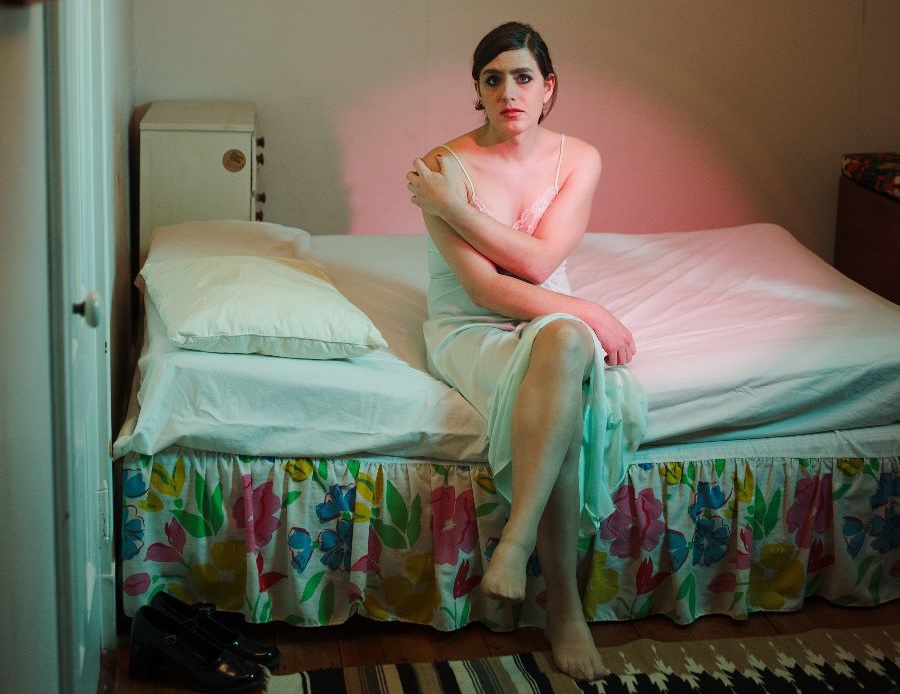
Liz Furman, known professionally as Ezra Furman, and I meet on a bitterly cold Sunday afternoon at Berlin’s Columbia Theater. Later that night, the beloved US indie artist will play a sold-out show to a crowd who have turned up well before her support band has begun, to be sure of their place at the front.
Furman, who has been releasing music since 2006, when she was the frontperson of the band Ezra Furman and the Harpoons, has a cult fanbase ranging across countries far from her native Chicago in the US. Yet she came to mainstream attention as late as 2019, when her heartfelt indie rock music, influenced by Bob Dylan and the Velvet Underground, was chosen to soundtrack the smash hit Netflix series “Sex Education”.
This tour is in support of Furman’s seventh solo album, “Goodbye Small Head”, released in May last year. It’s her most personal record yet, documenting the mystery illness she was struck down by in 2023 and the resulting impact on her mental health. It garnered this famously underappreciated artist rave reviews, though she tells me she won’t allow herself to read any of them!
Our conversation comes at a particularly emotive time, the day after Alex Pretti was gunned down by ICE agents in the US. Furman, who came out as transgender in 2021 and is the Jewish grandchild of Holocaust survivors, frequently and eloquently condemns the Trump administration on her social media. Her life experience has given her an acute understanding of what individuals have to fear from oppressive regimes. It’s difficult to talk about it all, she tells me, but she wants to talk.
She tells me as we sit down that she tends to take long pauses and it’s clear how much she carefully weighs her words. Yet she is funny too: she once wanted to be a comedian before she found her calling in music. In her songs, her passion and warmth find a natural alchemy. “I feel the urgent need to feel both anger and love at the same time,” she says. “Anger is the alarm bell when love and care are not being shown.”
How is the European tour going so far?
It’s exhausting and satisfying. I love the shows so much. It’s startling – the energy and love between the band and audience. And I just love my band. I thank my stars every night that they are so great at making these moments with me. We created the whole aesthetic we have together, and that gets obscured I guess by my name, but the contributions of my bandmates are huge.
“It’s testament to the joy of performing that I keep on doing it.”
In 2023 you announced you were taking a hiatus from touring because of its impact on you. Do you feel you’ve found the joy in touring again?
I never lost the joy. There are so many reasons to say, “This is too hard”. It’s testament to the joy of performing that I keep on doing it. I miss my family – I’m a parent and it’s hard to leave my partner and child. Then my health is not so good. I had a really long illness that started nearly three years ago and I still get pain and fatigue from that.
There’s a lot of pressure too. Indie venues are getting shut down so you have to play these corporate venues. Making money for giant corporations is not why I became an artist. But I think all these reasons not to tour show how much the good parts mean to me. I can feel how worthwhile it is, especially for people it really means something to. I feel like it’s a really good use of my life energy.
Do you feel a particular pressure from audiences right now, given what’s going on in the world?
Yeah. I’ve had kids say to me I saved their life. It reached a level of pressure that wasn’t good for me. In the end I had to put to one side any idea that young queer people might be depending on me.
I realised that what makes art useful to someone else is that it’s an expression of the artist’s freedom. The kind of connection I have with audiences only happens because I made art that’s true to myself. It’s such an honour and privilege, such a beautiful thing that anyone would say to me my music saved their life, but people save themselves with art all the time. I’m just trying to make the best art I possibly can.
“ I love this album and that’s the hardest thing to do – to make a record you truly love.”
Can we talk about your new record? “Goodbye Small Head” is such an incredible album.
Thank you – I like it a lot. But one thing I decided to do with this record was not read any reviews!
Isn’t that hard?!
It is – you’re tempted! But I read Carrie Brownstein’s [founder of rock band Sleater-Kinney] memoir. She told a story about reading a review of her new record right before she played a show she was really excited about, then she was just thinking about this crappy review for the whole show. It ruined it for her and she decided she’d never read another review!
After last time [Furman’s sixth album “All of Us Flames”, released in 2022, didn’t achieve the success she had hoped for and led her to part company with her record label]… If you lock into how your music is being received and the benchmarks of success like reviews and chart positions – it became really toxic for me. I started to feel disappointed all the time, which is insane. I know I’m like, underappreciated [laughs] but who gets to be appreciated at all?! It’s such a beautiful thing if anyone appreciates your music. So, I don’t even want to read good reviews. I already knew when we finished the record that we had succeeded. I love the record and that’s the hardest thing to do – to make a record you truly love. To create the songs that hit the “underground river” of what I need to say. You just have to dig until you hit that river.
It’s a very personal and intimate record.
Yeah, it’s really quite raw.
Has your relationship changed with the record as you’ve been touring it?
I feel a bit like a bad partner to some of the songs that we don’t ever play! I’m like “I love you too you guys!” I hope we eventually get to them all. I learn more about some of the songs the more I sing them. Some really still mystify me, like “Veil Song”. I worked on it for two years, but I still feel it’s like a jewel I found in the trash. Every time I sing it and am inside of it, I get that feeling again.
You said you wrote the first two tracks of the record – “Grand Mal” and “Sudden Storm” – in just two days, while others took much longer.
It’s so strange – there’s no rule for how I do this! I can’t rely on any process! But even songs I worked on for a long time, I do feel like the core of them arrived suddenly. It was just a lot of work to create a setting for that jewel. The realisation that there was something there worth working on just fell on me like rain.
I think your lyrics are so striking as well. There are musicians I really love – like Prince – who I would admit are not fabulous lyricists –
Wait – you don’t think so?! Maybe he’s a different kind of lyricist?
I don’t think Prince’s lyrics are always that poetic!
“Pussy Control” isn’t poetry to you?! [laughs] I don’t know – in a certain mood I think poetry and songwriting are merged, but mostly I think they’re different skills. I don’t like it when people publish their song lyrics like poetry books. It’s not poetry – it’s a fucking song!
But honestly, I would trade any of my songs for “Nothing Compares 2U”. I envy the skill of a good pop song writer. I have my skills that I’m proud of, but I’m not a hitmaker in that sense. I think I’m more in a different school of thought about it.
“I was at a wedding and the officiant led everyone in a sing-along to Elton John’s ‘Your Song’. I was like, ‘Oh, I’ve missed the whole point of making music!’”
You have a connection with your listeners that a lot of very commercially successful pop music will never achieve though.
Yeah, I know. But then I was at a wedding and the officiant led everyone in a sing-along to Elton John’s “Your Song”. I was like, “Oh, I’ve missed the whole point of making music! It’s about making a song that everyone knows and can sing together and feel in a moment of joy and togetherness. That’s only possible with a hit, man! I wish I’d written that song! Suddenly I just felt like a fool with my goals as an artist!
But I remember seeing you play [2013 single] “My Zero” at a show in England a few years ago and everyone was singing along. I really felt the love in that room.
It’s true – it does happen. But for it to be a bunch of strangers at a wedding – I was so jealous [laughs]!
I found the protest songs you’ve been posting on Instagram recently very powerful. I don’t want to ask you to talk about America. But can we talk a little about how you use social media? Have you found a way to use it in a way you’re comfortable with?
Well, you’re asking at a particularly horrible moment. Right before this interview I re-posted a protest song of mine [“My Country is Burning”] from a while back. But yeah, social media is hard for me, and it always has been. It seems to be a key part of my job, which I didn’t expect when I took this job! I had a MySpace page back then and I didn’t even want to make that. But my manager made me!
It always feels inadequate, but then when I see people using social media well, it can be very joyful. It can certainly be effective about getting the word out regarding organising or making phone calls or donating funds. There’s a lot of power in it that I try to sometimes use, but it doesn’t come naturally to me. I go back and forward between, Don’t make me look at this and I want to learn how to use this well.
“The killers in power have turned off empathy and humanity and I think art is part of what keeps us human. Acts of creativity are acts of freedom and they matter.”
As my country burns to the ground, and my nightmares about what a government can become are coming true, I’m doing performances and being an artist and asking myself: what is the point of this? But I believe it does do something important. Art is not the kind of thing that gets laws passed or gets people out of prison, but it sometimes gets people through their prison state. And it underlines being a feeling human being. The killers in power have turned off empathy and humanity and I think art is part of what keeps us human. Acts of creativity are acts of freedom and they matter. Making people’s lives better matters. When things are really dire like now, I think, why am I not working all day on making sure federal agents don’t come to my town and kill people? Then I take some breaths and remember I can support the people who do that. But I’m not one of the people who can actually do that. And also, this other thing I’m doing is not completely useless.
Do you see all your music as protest music, in one way or another?
I used to say that. I don’t know. It’s all freedom music and I think it’s meant to bolster our humanity. A lot of it is me trying to shake myself to remind myself: these feelings and meanings you have felt and known are actually real, and they’re not unsayable. They can be said and shared. There are a lot of dehumanising forces in our world. I’d like to be a humanising force, and you can think of that as protest music.