
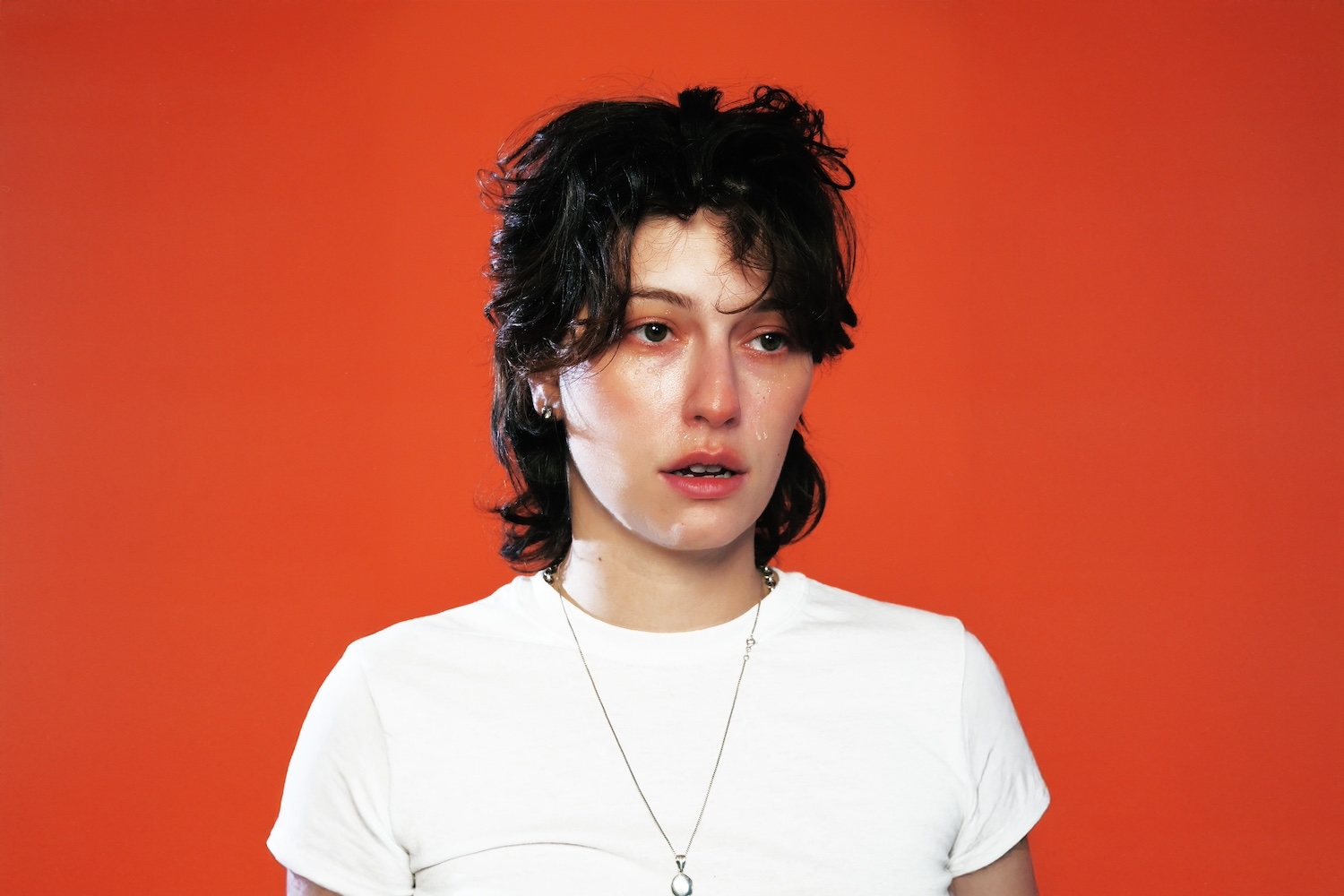
It’s a sunny morning in Berlin and King Princess, aka US singer/songwriter and now actress Mikaela Straus, is feeling really good. “Apart from the fact the world is burning,” she adds with a short laugh. It’s an interesting time for Straus, who first attracted a devoted queer fanbase in the late 2010s with her explicitly lesbian songs and openness about being gay and genderqueer. Straus released her 2018 EP, “Make My Bed” and the first two King Princess albums “Cheap Queen” (2019) and “Hold On Baby” (2022) on the Columbia Records imprint Zelig, headed up by Mark Ronson. Both records earned glowing reviews and awards nominations.
A lot has happened since, which has heavily influenced the third King Princess album “Girl Violence”, released on 12th September. Straus, still just 26, has moved from LA to Brooklyn, signed with indie label Section1 and navigated complex relationships and breakups. She’s also launched an acting career, starring alongside Nicole Kidman in the TV series „Nine Perfect Strangers“ and making her film debut in „Song Sung Blue” with Hugh Jackman. There is a lot to unpack. Our conversation also takes in change and rebirth, why “Girl Violence” is an album about “expert-level lesbianism” and what an artist’s role is when the world is burning.
Tell me about the process of making this record. I know it was very different from your first two albums.
Making “Girl Violence” was actually closest to how I made my first EP when I wasn’t signed. It was very familial – I made it with the same two people so the “through-lines” were easy. We were building it from scratch in the studio as a three piece band basically. It was a really calm, quite stoned process (laughs)!
I’ve made three albums now and every time, you get a little better. Or at least you learn what works and doesn’t. I really tried to keep this record insular and not ask for a lot of feedback till it was done. It gets complicated when you’re in the middle of letting something basically exit your body and people are like, “But wait, what if it was, like…?” With just the three of us, we felt like we were moving towards this finished piece with all these parts and it was going to take time and effort to get it there.
It’s really quite a groove-led album!
Yeah, it’s talking about a dark and sinister concept in a way that feels really pretty and dynamic. The only time I feel I’m effective in storytelling is through levity – being serious but in a humorous way – and that was my goal.
You’ve said that on “Girl Violence” you wanted to fight the misconceptions about you and create the album you were meant to make.
Yes! I’m a music nerd who grew up in a recording studio. It’s my “happy place” and the place I think I thrive most in. It’s almost like a therapeutic research facility for me. You’re investigating years’ worth of behaviour from yourself and others within those four walls. That was the goal – to make the album as honest, funny and relatable as possible. When I talk to my friends about the record, they tell me they can relate to individual songs. And I know they’ll be honest with me! They’ll be like, “Oh God, I was so Cherry [a fictional nemesis created by Straus for this album, who spreads chaos and destruction through various social media accounts] last night!” Or “I committed Girl Violence”. It’s putting a name to what already exists. What an amazing job I have to be able to put a name to something that’s already out there affecting people.
“To me it’s like I was given an extra gift. Being an artist is a gift but being gay too is just heaven!”
It’s an arresting title. “Girl” can be used in such an unserious, patronising way. B cvut you’re being much more honest and truthful about the challenges of lesbian relationships. Do you get weary of being asked questions about being a lesbian artist? As a lesbian, I always feel a bit bad about focusing on an artist’s sexuality. But it seems such an integral aspect of “Girl Violence”.
I think being gay is a massive gift. I’ve been saying this since the first interview I gave when I was 19, talking about what it means to be a queer artist. To me it’s like I was given an extra gift. Being an artist is a gift but being gay too is just, I mean, heaven!
It is, right?!
It’s hard to be gay though. Being gay is complicated and queer relationships are complicated in a way that is unique. It’s not that we’re different from straight people, but I do think that lesbianism is an Olympic sport. It’s not for the weak of heart!
My wife and I sometimes say lesbians argue in a far more intense way than straight couples maybe do, or even gay male couples!
Absolutely! You’re having an argument with someone who understands gender theory! That’s fucking hard!
It’s an interesting time – a difficult time – to be an out queer artist in the world. We have Chappell Roan but her trajectory is not normal for most LGBTQ+ artists.
It is a really difficult time. America has historically not supported gay people. Now it’s outwardly saying that once again: We don’t support you. Right now, this is one of the most hateful administrations we’ve ever seen. But you can’t get rid of queer people because we make all the art!
“Charli xcx was ahead of the curve and she got her flowers. When I look at artists’ careers I admire, it’s usually the ones that have longevity and chapters.”
When I’m listening to your music, I ask myself – why are you not an even bigger artist than you are? Do you think being – not outspoken but honest about being queer – has affected that?
I came out on the scene when being queer was just starting to be “trendy”. The landscape was so different back in 2018. Now it’s really trendy and everyone wants to be gay and make a gay or lesbian song. I think I just came along a little bit early. I was scrutinised differently than I think would happen now. I was 19 and being asked questions about what it meant to be gay, being asked to speak for the entire queer community. No one should be asked to do that, and also no one who’s 19 should be talking. I was not qualified to be fucking talking back then! But I learned a lot of lessons about the industry and what it means to be a bit of a trailblazer. Oftentimes you won’t be the most “nodded to” person. Now I’m 26 and I still feel like I’m becoming an adult. My frontal lobe just formed! I guess I’m like, slow and steady wins the race. I’m in no rush. The world will catch up. Charli xcx was ahead of the curve and she got her flowers. When I look at artists’ careers I admire, it’s usually the ones that have longevity and chapters. Hopefully I’ll be doing this till I fucking die!
I read you saying that “Girl Violence” is the record that 15 year old you needed. I would definitely have appreciated this record when I was 15!
Yes, it’s like a cautionary tale. I think it’s dealing in expert-level lesbianism really. I’ve been gay so long, it’s not fun any more! Comparing myself now to when I started out, I do think I’m qualified to speak now. I have done my time. The record is the story of someone who loves chaos. It’s my version of [Leonardo Di Caprio’s 2015 epic Western drama] “The Revenant”.
Where did “RIP KP” come from?
That song is the beginning of the “Girl Violence” journey: the sexiness, the “killed by pussy” vibe. It allows for the rest of the story to be told. I wanted to axe myself so I could start over. There have been a lot of rebirths for me – moving, changing labels, going into the indie system. It’s been like a little leaf growing throughout all of this!
“I appreciate that my label trusts me and loves my music. That was really cathartic for me.”
How has moving to an indie label been for you? There is a rumour that you first turned down a major label at the age of 11.
Haha no! It’s funny how things get twisted online. That didn’t happen! Nobody was offering me a record deal at 11 but there was some noise around me when I was a teenager and I was definitely in a position to start laying the groundwork for what I wanted when I was older. I grew up in a studio [Strauss’s father was a successful recording engineer] and I watched artists sign and then get shelved or sign, have things go well and then it turned. I was able to watch the effects of the system on artists so I definitely came in with a more cautious understanding of what signing a deal meant.
When I started out, the idea of an indie label was really different to now. The biggest artists in the world right now – chances are some of them are on indie labels. I think my journey is extremely influenced by the changing state of the industry and the fact labels are no longer the arbiters of taste or content any more. They’re more businesses than creative co-operatives. You either fit into that structure and play that game or you don’t. I was interested in an environment that was super into putting art first. I’m competitive enough with myself. I know what I want and I understand the business. I appreciate that my label trusts me and loves my music. That was really cathartic for me.
You’ve recently launched an acting career. How does that feed your music career and vice-versa?
Both music and acting are about using your body as a medium for storytelling. Acting just feels like exercising a different muscle. I’ve become a bit less precious and more honest with my performance after being on camera and spending time investigating characters and so on. It’s all symbiotic and I feel really lucky to be able to explore different mediums and take them back into my first love, which is music. But I love acting! I definitely have the bug!
It seems like you’re in a really good place right now!
Yeah I feel pretty good. I live a pretty blessed life where I get to make art all the time. I have really great friends and family and there’s not much to complain about. Other than that the world is burning (laughs).
“I think bringing people joy through music is a form of rebellion.”
There’s been so much discussion after Glastonbury especially about politics and what is the right way to respond in art.
I think bringing people joy through music is a form of rebellion. I think making political statements is a form of rebellion. There is no one right way. There are just a lot of pieces contributing. In artistic communities we don’t tolerate bigotry. Art is not a place for people to divide. It’s a place to come together, enjoy and feel empathy. There is a serious lack of empathy in the world right now. I think art has the power to bring people together and artists know when the right time is to make a statement, in whichever way is right. Be tactful, be creative and take time and care in the things you say and do, which is what I always hope to do. If I can provide a place for gay people to come together and dance and party and scream lyrics and cry and meet people, then I’m doing my job.
It is important for me to bring the show into a physical space and have connection with the people in the audience. I don’t feel good unless I’m playing live. It’s such a transfer of energy and I get just as much from it as the audience do. I’ve watched so many incredible moments from onstage, happening in the crowd. I feel lucky for that. I have really special, funny, witty, cool fans and they teach me a lot.
“Girl Violence“ by King Princess is released 12th September 2025 on Section1.